Wednesday, January 2, 2019

Kato? ... Dare I cross to the dark side?

I think we can agree my posts have been left a little thin on the ground... for a while at least.  This is because life got in the way.  Loss of a job.  Employment under a real sociopath.  Loss of a sibling.  And starting up my own business and focusing on that.  Occasionally I have pulled out my rolling stock and set up some temporary track work on the dining table and before long it has to go away again.  I'm sure we've all been there.  Even the wonderful Jerry of Quinntopia fame is on hiatus (sadly for all of us fans).

I have for some reason started to develop a quiet admiration of the Kato system.  Now let me say first of all I was never attracted to it off the bat.  I was laying track and traditional ballast when I was still a teen (okay that's at least 21 years ago now).  Like many people my initial reaction would be "Eww! ... You cannot be serious?!?!"  But, I have observed many people have taken to it, and the Quinntopia layout was a wonderful example.  But, there are people still who take great pride in weathering and ballasting Kato track in to a life like form.  This raises the counter productive question of then why they bother?

I'm torn in not wanting a fake look that I could have surpassed 20 years ago myself with my amateur skills, opposed to utilising a quality track work that would not be inhibited by my lack of skill (and time) in other areas.  There are other areas I need to completely learn on, such as wiring and basic signalling.

I am looking to build an 8ft by 4ft (give or take) layout, that can be perhaps built on 2 or 3 sections for easy dismantling.  I have fallen for this design from the Kato track plans online.

Richfield & Fond du Lac Railroad


This layout offers everything I desire:
  • Ability to run several decent length consists
  • The ability to modify the bottom to incorporate a decent multi platform station able to properly take five to six passenger cars
  • Ability to move some of the scenic loop track north to expand on the stabling / fiddle yard
My focus is passenger trains with some odd freight focus.  I have always wanted a reasonable run through station and not a line ending terminus.  This is because this is representational of my life growing up around the trains where I live in my environment.  We have a mix of suburban commuter sets and regional inter-city trains passing by.  I enjoy nothing more than the sight of a train arriving, departing, or, speeding through a station on an express pass by.

If anyone can still see this I would love to hear your (experienced) feedback on Kato Unitrack.  The good, the bad and the ugly.

Friday, July 1, 2011

Fleet Profile - German DB Class 111 Bo Bo Locomotive (Minitrix)


Currently this little gem produced by Minitrix is the pride of my fleet in all operating measures, including:

  • Speed
  • Reliability
  • Stability
  • Low speed running
  • Noise level

In short this has been one of the best (out of the box) locomotives I have ever bought.


The locomotives in real life have been a signature feature of the German railways dating back to the fifties when the Class 110 was designed.  The class 111 was designed in the 1970's.  High speed electric locotomotives being in high demand in Germany (and indeed greater Europe) they were the locomotive of their day.  227 locomotives were built between 1974 and 1984.  At the time of writing it is believe most of these locotmotives remain in active service.


For more information on these wonderful locomotives please refer to Wikipedia.

Class 111 - Built 1974 - 1984 reamaining in service
http://en.wikipedia.org/wiki/DB_Class_111


Class 110 (aka E 10) - Built 1956 - 1969 retirement commencing 2000
http://en.wikipedia.org/wiki/DB_Class_E_10

Wednesday, March 30, 2011

Fleet Profile - Graham Farish, Royal Scot Class, 46159 The Royal Air Force (Pride & Propulsion)


Locomotive 41659 "The Royal Air Foce" in British Railways dark green with 'late crest' lviery of the 'Royal Scot' class of locomotive is the newest addition to my fleet and currently taking centre stage on many runs.


Disigned in the mid to late 1920's by Sir Henry Fowler, 70 of the Royal Scot class (4-6-0) locomotives were built between 1927 and 1930 and named after regiments of the British armed forces.  The Farish (Graham Farish)  model is produced in the locomotive's final incarnation before the withdrawal from revenue service finally in the mid sixties.


Two locomotives are known to survive in (tourist) operating service today, these being:

  • Locomotive 46100.  Class: Royal Scot.  Name Plate: Royal Scot
  • Locomotive 46115.  Class: Royal Scot.  Name Plate: Scots Guardsman


Thus far the loco has proven a wonderful little unit, running extremely smooth and having little in the way of problems what so ever.  The images above simply display some table top running in which it handles tight curves and point switching with aplomb (the front lead wheels never routinely go astray).  It is not the most powerful of locomotives, but given all I am asking is for it to haul a half dozen Farish-made British Pullman cars (which are extremely light weight and free-wheeling) it is proving itself capable and then some.


Sunday, March 27, 2011

Fleet Profile - Minitrix Orient Express (Heavyweight Series)


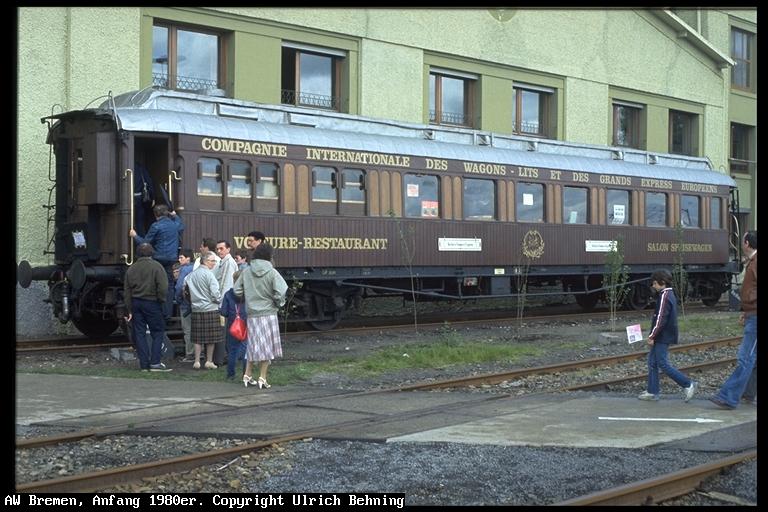
Growing up as a kid of humble origins and as an avid lover of railways I soon developed a taste for the great railways of Britain and Europe where the romance of railway travel, in my humble opinion, reached it's zenith with the Orient Express (thanks to it's visionary mastermind Georges Nagelmackers who founded the famous Compagnie Internationale des Wagons-Lits in the late 1800's).  And therein lies the rub, when we think of the Orient Express we must remember to separate the physical train from the journey.  While the journey may be the Orient Express, the actual hardware (the rolling stock) is the product of Nagelmackers and his "Wagons-Lits" company.


Wagons-Lits, apart from fielding rolling stock for the Orient Express, fielded rolling stock for trains all across Europe, including:

  1. Orient Express - Paris to Istanbul/Constantinople (also linking to the port of Calais and the British Pullman service to London as time went on).
  2. Nord (Northern) Express - Paris to St Petersburg
  3. Sud (Southern) Express - Paris to Lisborn in Portugal (by connecting with the Nord Express in Paris, connected St Petersburg to Lisborn)
  4. Train Bleu - Calais/Paris to Nice in the south of France (taking holiday makers to the French coast)
  5. Night Ferry - London to Paris (via a ferry transporting the coaches from Dover to Dunkirk at the narrowest point of the English Channel).  Note the modern Venice Simplon Orient Express transports passengers by ferry to Calais from Folkstone England, but coaches are not ferried on this service.
The Minitrix "Orient Express" set includes 2 CIWL type F baggage cars, 4-axle car with a wood body in teak and a conductor's cupola.  Originally produced in the early twentieth century.  A WR type dining car, such as can be seen here WR Type Heavyweight Dining Car.  And two WL type sleeping cars.  A photo of which is displayed.


The Minitrix set is hauled by a variation of the French SNCF 230 E 4-6-0 locomotive without smoke deflectors.  My locomotive is pictured below.


If someone is able to help me out with a real life photo of this locomotive (without smoke deflectors and the correct cylindrical boiler and firebox housing I would greatly appreciate it.

Tuesday, March 15, 2011

Back on Track ... Blogging that is ...

Woah, two blogs in two days (I'm practically a workaholic?).  While my inspiration levels are up I thought I'd pop in another post in the mean time to say that I will soon start blogging about my current collection (and ambitions therein), given I have little to report on in the way of layout development.  Here's hoping I can stay on track at least with the blogging ...

Monday, March 14, 2011

Procrastination Much ... ???

Sigh ... This blog has become an ode to my own procrastination. Which is really quite depressing. But for anyone out there who has come across my blog let me tell you that the last 18 months have been spent establishing ourselves into our brand new (new build) house. So suffice to say any cash we have had has gone into all sorts of projects around the house including, construction, front yard, back yard, new furniture, vegie gardens, rain water tank, security and so forth. And we still have a long way to go.

Also too at this point I am looking for a new job which isn't a thrilling experience (hopefully something will come through soon). For a long time I had wanted to work from home in my own business (still do) but, as an accountant starting from scratch getting the client build required up is not the overnight job that some people seem to think it is. For example, unlike many friends in other fields I can't readily show people examples of work I have done. Whilst this is disappointing I am refocusing my search for commercial roles within a half hour from home.

However, in the mean time I have recently regained some vitality in my interest and determination to get a layout off the ground. Also too if I return to a commercial role, my home office can be freed up to house a modest layout. So I guess there is a silver lining.

I visited an exhibition this weekend past, the first I have been to in quite a while and I was introduced to the concept of "T-Trak" modelling in N-Scale and the friendship groups that grow out of this. Now this is very appealing to me, as sadly I do have to admit I had more knowledge of railways when I was 12 then I do these days (at the ripe old age of 33). So a network group of like-minded enthusiasts would be a good thing for me to get in to. Not to mention that I haven't done any scenery work since I was 15-16 ... we might as well say I am starting from scratch. In my early teens I had constructed a simple up and over double loop with a couple of sidings and a station (when I say double loop, I refer to the same direction "not" as in a figure eight.

I would like to know what people think about T-Trak modelling. I know it has some strong limitations and some strong opposition from the traditional modelling fraternity. I don't want to make any mistakes in this decision. Whilst I am not about to give up on my (modest) tri-level design, which has been a dream for years, I have to concede it still only remains on paper. My frustrations at my own lack of development are getting to me now. For a while I was able to meet those desires by building up my locomotive and rolling stock collection, but I have more than enough for the moment. Particularly when you consider I have nothing ready to run them on aside from sections of Peco track that have to be taken out, set up, dissembled and reassembled on the dining table.

I am ready for something now a little more permanent. But do I stick with my original plans (which could be somewhat larger than is convenient) or move to the T-Trak method, which seems to lack imagination in some senses and relies on the group effort aspect of exhibiting . If my allotted space is not much more than a door or a reasonable dining table (for example), can I create an inspiring layout on the T-Trak method? Because I can really see at least how getting started on the T-Trak method in itself could be perpetually inspiring ... but simply to run trains in endless circles maybe not so much. What about elevations, yard operations or perhaps a round house?

Well clearly I have some more thinking to do ... if anyone is out there reading this I'd value your input.

Mike

Saturday, August 22, 2009

Managing an Eclectic Layout

I am constantly faced with the quandry of how to proceed with my layout development knowing I don't have a constant theme set in stone. This is particularly frustrating for me in setting the scene on the layout beore even rolling out the various fleets. The problem is I have a love affair with various trains from the late nineteeth and early twentieth centuries through to twenty first century high speed trains. So the theme of the layout needs to accomodate a 4-6-2 steam hauled heavy weight passenger service from the pre-1920's Europe and Australia through to the modernist Eurostar and TGV's ... without winding up looking ridiculous.

Whilst my love affair harks back to the romance of the rails being founded in passenger traffic,my vision isn't void of freight traffic and yarding activities. However, passenger focus remains the prime driving force behind my motivation to establish a layout... So I suppose this is something of a starting point. This still leaves me with a dilema as to the time period of the layout. Too modern and steam traffic will look out of place and too old and the opposite will be true for modern fleet items, which I must admit there really isn't anything too modern in my fleet at this time.

I'd appreciate any comments from any followers how they have dealt with this same issue in the development of their own layouts.

Saturday, July 26, 2008

Victorian Rail Glory Ahead

Welcome back,

I have been doing some research and have re-enacted my old account 'ozimica' on the 'Rail Page' internet forum. In my quest to turn some American Bachman Pennsylvania coaches in to mock versions of the Victorian Railways AE and BE style coaches.

I have already decided I will have to put up with blatant structural drifferences between the Penn State coaches and the desired VicRail cars. However my barstadised versions will be only for first glance impressions and will not most likely be running alongside other products that it can be comparred with. So I am quite optimistic that it will be a success.


PENNSYLVANIA COACHES


VIC RAIL COACHES (Circa 1905-1915)


As I said by the time you scale these beauties down to N-scale I am confident of a passable product. Below is an example someone else showed me. Personally I think it has come up quite poorly and hasn't been done carefully. But I take my hat off to the modeller for trying as the effect is still quite successful.  Note the car (and a bit seen here) are seen in the modern Steamrail preservation group's striking red livery and not in the traditional heritage colours which were more subdued.

CONVERSION EXAMPLE OF BACHMAN PENNSYLVANIA CAR


Well that's it for now. Thank you for reading and please look out for future posts.


Mike!


**** UPDATE**** - ACTUAL CONVERSIONS


Working with an uncle of mine who is into high end modelling we have managed to do a quick slap up job on three Bachman Pennsylvania cars, two of which are pictured for your information below.  These cars have been painted in the modern Livery of the Steamrail preservation gorup (which too my poor knowledge my be remnants of the final colours prior to retirement of the cars from revenue service in the late 80's - 90's).


While a far far cry from the real deal, I am thrilled with how the cars have come out.  I have three more left to experiment on, the only change I might make is for a glossier paint.

Wednesday, July 23, 2008

Fairhaven - Vision of the Future


"Welcome to Fairhaven!"

Fairhaven is the working title for my planned N-Scale layout which I expect to begin constructing within the next twelve months. First things first, I'm building a new house, so priorities aren't leading to Fairhaven directly, alas a few delays will be expected on this journey.

Fairhaven (working title) is the name I am bestowing on my layout which will be a modest design in N-scale which will be an eclectic scene of seaside hills meet city edge. The design era will be 1850 - 1920 architecture set in modern times. So picture if you will your classic country or inner city style and hopefully you will have a sense of where we are heading.

In rectangular shape it is planned the line begins at the satellite-city station of Fairhaven and town fringe on the left hand edge of the layout. The back end of the platforms will be masked by a station concourse over the platforms with ramps/stairs leading down to the platform area. This concept has been designed to cheat the station illusion allowing for the confines of domestic household space that all too often impede on our imagination. The platform proper will allow for the display of 3-4 coaches and a locomotive.

The layout is planned to run over a three level structure (and drawings I have prepared will be posted soon so please keep an eye out).

Level 2 will be the ground level equivalent.

Level 3 will incorporate hills bridges and flyovers etc.

Level 1 (basement) will be in the baseboard substructure incorporating hidden sidings for storing rolling stock when they layout is in use. A perspex fascia around the frame will allow for visibility and hinged to allow access following seismic events.

The lines, following Australian and British regulation travel on the left. Leaving the station in an anti-clockwise direction the line swings to the left across the lower plains along the front edge of the base board before swinging left again and plunging into the lush green earth of the Fairhaven foothills after a few moments we emerge into a central revene leading to the inner plains where we wrap around the outer edge of the foothills and begin our ascent up the midst of the foothills. Here we arrive at the as yet undisclosed upper country station where pause momentarily exchanging commuters and day trippers alike.

Leaving the second station a lengthy interstate freighter may come trundling out of the upper tunnel on it's approach down the hill in the clockwise direction. We enter now into the darkness of the upper tunnel and those listen carefully can still catch the tail of the freighter lumber past on the clockwise track.

As our train picks up speed in the dark tunnel the line dips into a comfortable slope that takes us back down to ground level (level: 2) along the back edge. Just as passengers are feeling weary from our journey our train pours out of the darkness making it's final approach toward the catacombs under the town and station structure, and again we are back in the darkness and losing speed. As passengers are collecting their belongings the train again pulls to the left and creeps slowly back into the Fairhaven platforms.

After a full disembarkment an empty train leaves Fairhaven for the last time, again swinging to the left as we clear the platforms. The track sloping down into a man-made brick and concrete cutting. The driver stops at a signal just prior to the tunnel portal. The Yard Manager is ensuring the entrance line on the inner yards is clear. As the train sits an express intercity service whisks through the centre of the yards on the clockwise line charging through the portal, up the cutting where our train waits, whistling through the station catching waiting passengers unaware and tearing into the catacomb lines leading to the country lines.

Returning to our train the driver receives the all clear and gently leads our train into the subterranean yards to his designated position at inner anticlockwise siding number 2. Climbing out of his cabin the driver pauses to admire the various trains visiting his hometown of Fairhaven. There is six lines in total across. The up and down main lines pass down the centre of the yard with two outer passing loops on both sides. Anticlockwise lines 1, 2 and 3 on the inside of the structure and clockwise lines 1, 2 and three on the outside of the structure (space dependent the outer number three lines may face forced cuts only allowing 4 instead of 6 trains at the ready.

Finally the driver stops to admire the eclectic variety of trains in town for the international rail celebrations. There are two Wagons-Lits orient-express Pullman car trains. One the classic and well known service from the art-deco era of the 20's and 30's.


The other the more vintage six axle consist in royal blue and brown, fitted with hand turned brass and raised roof-lines she's a rare and beautiful gem to behold. Next is a modern German diesel electric locomotive hauling a five car set of passenger coaches in navy and creme. Beautiful in her own right she's out of her depth next to her older ancestors.


The central clockwise line is holding a series of miscellaneous freight and container wagons which recently thundered through town. Clockwise line 2 is presently clear, but the driver smiles as hears the line begin hissing.

Finally his favourite, a refurbished six car set of Victorian Red-Rattlers being hauled by a bull nose diesel. The coaches were originally sourced by the American Bachman company (from the Pennsylvania Railroad) and have been lovingly converted into the Victorian style.


The driver heads toward the drivers pavilion and heads right in "Michael" he hears as he closes the door. There's one of his workmate mates raising a mug as if to ask "would you like a cuppa?". Mike nods with a grin, "just what I need" as he slouches into a wooden pue-like seating coral by the window, his energy sapped out of him.